Note
Go to the end to download the full example code.
MeshConvergence#
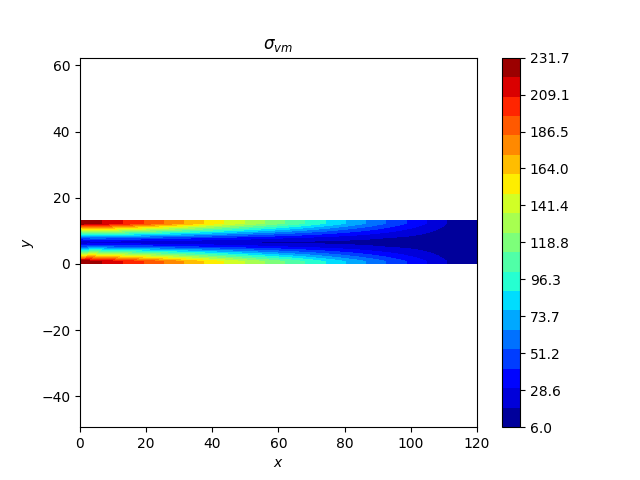
Verification of energy convergence for a bending beam for all available elements.
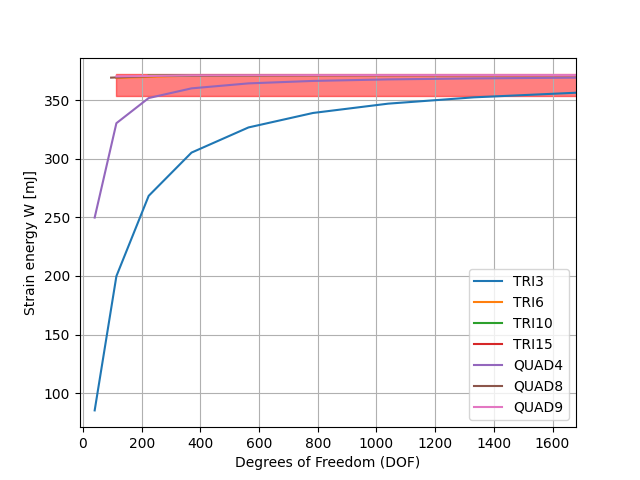
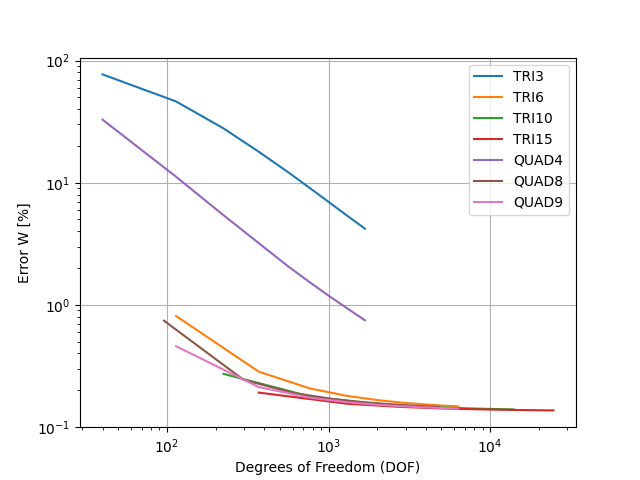
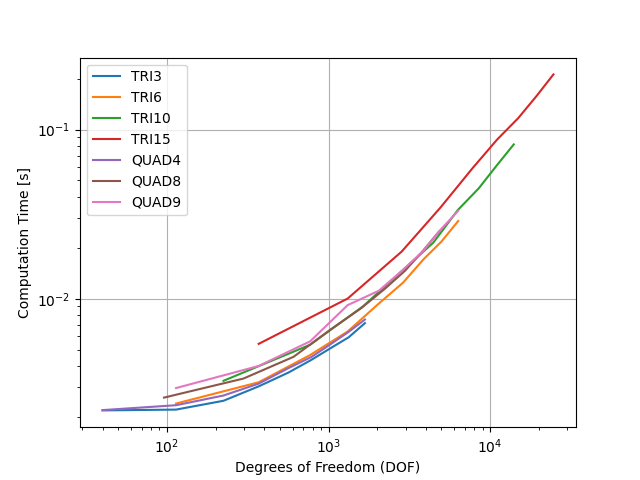
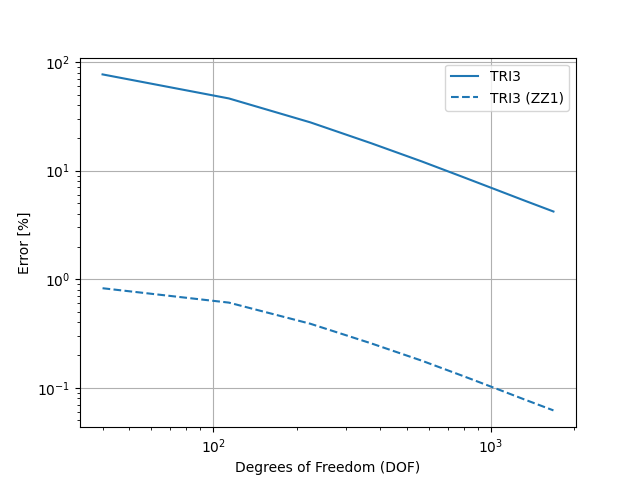
Elem: TRI3, nby:  1, Wdef = 85.307, error = 7.71e-01
Elem: TRI3, nby:  2, Wdef = 199.836, error = 4.63e-01
Elem: TRI3, nby:  3, Wdef = 268.382, error = 2.79e-01
Elem: TRI3, nby:  4, Wdef = 305.294, error = 1.79e-01
Elem: TRI3, nby:  5, Wdef = 326.756, error = 1.22e-01
Elem: TRI3, nby:  6, Wdef = 339.109, error = 8.85e-02
Elem: TRI3, nby:  7, Wdef = 347.06, error = 6.71e-02
Elem: TRI3, nby:  8, Wdef = 352.445, error = 5.26e-02
Elem: TRI3, nby:  9, Wdef = 356.373, error = 4.21e-02
Elem: TRI6, nby:  1, Wdef = 369.006, error = 8.10e-03
Elem: TRI6, nby:  2, Wdef = 370.965, error = 2.84e-03
Elem: TRI6, nby:  3, Wdef = 371.253, error = 2.06e-03
Elem: TRI6, nby:  4, Wdef = 371.354, error = 1.79e-03
Elem: TRI6, nby:  5, Wdef = 371.405, error = 1.65e-03
Elem: TRI6, nby:  6, Wdef = 371.433, error = 1.58e-03
Elem: TRI6, nby:  7, Wdef = 371.451, error = 1.53e-03
Elem: TRI6, nby:  8, Wdef = 371.463, error = 1.50e-03
Elem: TRI6, nby:  9, Wdef = 371.472, error = 1.47e-03
Elem: TRI10, nby:  1, Wdef = 371.008, error = 2.72e-03
Elem: TRI10, nby:  2, Wdef = 371.36, error = 1.78e-03
Elem: TRI10, nby:  3, Wdef = 371.433, error = 1.58e-03
Elem: TRI10, nby:  4, Wdef = 371.463, error = 1.50e-03
Elem: TRI10, nby:  5, Wdef = 371.479, error = 1.45e-03
Elem: TRI10, nby:  6, Wdef = 371.489, error = 1.43e-03
Elem: TRI10, nby:  7, Wdef = 371.495, error = 1.41e-03
Elem: TRI10, nby:  8, Wdef = 371.499, error = 1.40e-03
Elem: TRI10, nby:  9, Wdef = 371.503, error = 1.39e-03
Elem: TRI15, nby:  1, Wdef = 371.309, error = 1.91e-03
Elem: TRI15, nby:  2, Wdef = 371.445, error = 1.55e-03
Elem: TRI15, nby:  3, Wdef = 371.478, error = 1.46e-03
Elem: TRI15, nby:  4, Wdef = 371.493, error = 1.42e-03
Elem: TRI15, nby:  5, Wdef = 371.501, error = 1.40e-03
Elem: TRI15, nby:  6, Wdef = 371.505, error = 1.39e-03
Elem: TRI15, nby:  7, Wdef = 371.508, error = 1.38e-03
Elem: TRI15, nby:  8, Wdef = 371.511, error = 1.37e-03
Elem: TRI15, nby:  9, Wdef = 371.512, error = 1.37e-03
Elem: QUAD4, nby:  1, Wdef = 249.865, error = 3.28e-01
Elem: QUAD4, nby:  2, Wdef = 330.381, error = 1.12e-01
Elem: QUAD4, nby:  3, Wdef = 351.849, error = 5.42e-02
Elem: QUAD4, nby:  4, Wdef = 360.11, error = 3.20e-02
Elem: QUAD4, nby:  5, Wdef = 364.354, error = 2.06e-02
Elem: QUAD4, nby:  6, Wdef = 366.455, error = 1.50e-02
Elem: QUAD4, nby:  7, Wdef = 367.75, error = 1.15e-02
Elem: QUAD4, nby:  8, Wdef = 368.603, error = 9.19e-03
Elem: QUAD4, nby:  9, Wdef = 369.241, error = 7.47e-03
Elem: QUAD8, nby:  1, Wdef = 369.262, error = 7.42e-03
Elem: QUAD8, nby:  2, Wdef = 371.115, error = 2.43e-03
Elem: QUAD8, nby:  3, Wdef = 371.315, error = 1.90e-03
Elem: QUAD8, nby:  4, Wdef = 371.386, error = 1.70e-03
Elem: QUAD8, nby:  5, Wdef = 371.424, error = 1.60e-03
Elem: QUAD8, nby:  6, Wdef = 371.445, error = 1.55e-03
Elem: QUAD8, nby:  7, Wdef = 371.46, error = 1.51e-03
Elem: QUAD8, nby:  8, Wdef = 371.47, error = 1.48e-03
Elem: QUAD8, nby:  9, Wdef = 371.478, error = 1.46e-03
Elem: QUAD9, nby:  1, Wdef = 370.315, error = 4.58e-03
Elem: QUAD9, nby:  2, Wdef = 371.231, error = 2.12e-03
Elem: QUAD9, nby:  3, Wdef = 371.375, error = 1.74e-03
Elem: QUAD9, nby:  4, Wdef = 371.428, error = 1.59e-03
Elem: QUAD9, nby:  5, Wdef = 371.456, error = 1.52e-03
Elem: QUAD9, nby:  6, Wdef = 371.471, error = 1.48e-03
Elem: QUAD9, nby:  7, Wdef = 371.481, error = 1.45e-03
Elem: QUAD9, nby:  8, Wdef = 371.488, error = 1.43e-03
Elem: QUAD9, nby:  9, Wdef = 371.494, error = 1.42e-03

WSA = 372.0206 mJ

Mesh : 703.348 ms
Boundary Conditions : 707.388 µs
Matrix : 1.008 s
Solver : 696.789 ms
Resolutions : 1.379 s
PostProcessing : 170.383 ms
Display : 825.457 ms
 13 import matplotlib.pyplot as plt
 14 import numpy as np
 15
 16 from EasyFEA import (
 17     Display,
 18     Folder,
 19     Models,
 20     Tic,
 21     Mesher,
 22     ElemType,
 23     Simulations,
 24     Paraview,
 25 )
 26 from EasyFEA.Geoms import Domain, Point
 27
 28 if __name__ == "__main__":
 29     Display.Clear()
 30
 31     # ----------------------------------------------
 32     # Configuration
 33     # ----------------------------------------------
 34     dim = 2  # Define the dimension of the problem (2D or 3D)
 35
 36     # outputs
 37     folder = Folder.Results_Dir() + f"{dim}D"
 38     plotResult = True
 39     makeParaview = False
 40
 41     # geom
 42     L = 120  # mm
 43     h = 13  # Height
 44     b = 13  # Width
 45
 46     # model
 47     E = 210000  # MPa (Young's modulus)
 48     v = 0.25  # Poisson's ratio
 49     material = Models.Elastic.Isotropic(dim, thickness=b, E=E, v=v, planeStress=True)
 50
 51     # load
 52     P = 800  # N
 53
 54     # expected energy
 55     WdefRef = 2 * P**2 * L / E / h / b * (L**2 / h / b + (1 + v) * 3 / 5)
 56
 57     # ----------------------------------------------
 58     # Mesh
 59     # ----------------------------------------------
 60     isOrganised = True
 61
 62     # List of mesh sizes (number of elements) to investigate convergence
 63     if dim == 2:
 64         list_N = np.arange(1, 10, 1)
 65     else:
 66         list_N = np.arange(1, 8, 2)
 67
 68     # Lists to store data for plotting
 69     times_elem_N = []  # times for element type and N size
 70     wDef_elem_N = []  # energy
 71     dofs_elem_N = []  # dofs
 72     zz1_elem_N = []  # zz1
 73
 74     # ----------------------------------------------
 75     # Simulations
 76     # ----------------------------------------------
 77
 78     # Loop over each element type for both 2D and 3D simulations
 79     elemTypes = ElemType.Get_2D()[:] if dim == 2 else ElemType.Get_3D()
 80
 81     # elemTypes = [elem.name for elem in elemTypes.copy()]
 82
 83     mesher = Mesher()
 84
 85     for e, elemType in enumerate(elemTypes):
 86         times_N = []
 87         wDef_N = []
 88         dofs_N = []
 89         zz1_N = []
 90
 91         # Loop over each mesh size (number of elements)
 92         for N in list_N:
 93             meshSize = b / N
 94
 95             # Define the domain for the mesh
 96             domain = Domain(Point(), Point(x=L, y=h), meshSize)
 97
 98             # Generate the mesh using Gmsh
 99             if dim == 2:
100                 mesh = mesher.Mesh_2D(domain, [], elemType, isOrganised=isOrganised)
101                 volume = mesh.area * material.thickness
102             else:
103                 mesh = mesher.Mesh_Extrude(
104                     domain,
105                     [],
106                     elemType=elemType,
107                     extrude=[0, 0, b],
108                     layers=[4],
109                     isOrganised=isOrganised,
110                 )
111                 volume = mesh.volume
112             # Ensure that the volume matches the expected value (L * h * b)
113             assert np.abs(volume - (L * h * b)) / volume <= 1e-10
114
115             # Define nodes on the left boundary (x=0) and right boundary (x=L)
116             nodes_x0 = mesh.Nodes_Conditions(lambda x, y, z: x == 0)
117             nodes_xL = mesh.Nodes_Conditions(lambda x, y, z: x == L)
118
119             # Create or update the simulation object with the current mesh
120             if e == 0 and N == list_N[0]:
121                 simu = Simulations.Elastic(mesh, material)
122             else:
123                 simu.Bc_Init()
124                 simu.mesh = mesh
125
126             # Set displacement boundary conditions
127             simu.add_dirichlet(nodes_x0, [0] * dim, simu.Get_unknowns())
128             # Set surface load on the right boundary (y-direction)
129             simu.add_surfLoad(nodes_xL, [-P / h / b], ["y"])
130
131             tic = Tic()
132
133             # Solve the simulation
134             simu.Solve()
135             simu.Save_Iter()
136
137             time = tic.Tac("Resolutions", "Total time", False)
138
139             # Get the computed deformation energy
140             Wdef = simu.Result("Wdef")
141
142             # Store the results for the current mesh size
143             times_N.append(time)
144             wDef_N.append(Wdef)
145             dofs_N.append(mesh.Nn * dim)
146             zz1_N.append(simu.Result("ZZ1"))
147
148             if elemType != mesh.elemType:
149                 print("Error in mesh generation")
150
151             print(
152                 f"Elem: {mesh.elemType}, nby: {N:2}, Wdef = {np.round(Wdef, 3)}, "
153                 f"error = {np.abs(WdefRef - Wdef) / WdefRef:.2e}"
154             )
155
156         # Store the results for the current element type
157         times_elem_N.append(times_N)
158         wDef_elem_N.append(wDef_N)
159         dofs_elem_N.append(dofs_N)
160         zz1_elem_N.append(zz1_N)
161
162     # ----------------------------------------------
163     # Results
164     # ----------------------------------------------
165     # Display the convergence of deformation energy
166     ax_Wdef = Display.Init_Axes()
167     ax_error = Display.Init_Axes()
168     ax_times = Display.Init_Axes()
169     ax_zz1 = Display.Init_Axes()
170
171     print(f"\nWSA = {np.round(WdefRef, 4)} mJ")
172
173     for e, elemType in enumerate(elemTypes):
174         # Convergence of deformation energy
175         ax_Wdef.plot(dofs_elem_N[e], wDef_elem_N[e])
176
177         # Error in deformation energy
178         Wdef = np.array(wDef_elem_N[e])
179         error = (WdefRef - Wdef) / WdefRef * 100
180         ax_error.loglog(dofs_elem_N[e], error)
181
182         # Computation time
183         ax_times.loglog(dofs_elem_N[e], times_elem_N[e])
184         # ax_Times.plot(listDofs_e_nb[e], listTimes_e_nb[e])
185         # ax_Times.set_xscale('log')
186
187         # ZZ1
188         if elemType == elemTypes[0]:
189             last = ax_zz1.loglog(dofs_elem_N[e], error, label=f"{elemType}")
190             ax_zz1.loglog(
191                 dofs_elem_N[e],
192                 zz1_elem_N[e],
193                 ls="--",
194                 color=last[0]._color,
195                 label=f"{elemType} (ZZ1)",
196             )
197
198     WdefRefArray = np.ones_like(dofs_elem_N[0]) * WdefRef
199     WdefRefArray5 = WdefRefArray * 0.95
200     # WdefRefArray5 = WdefRefArray * 1
201
202     # Deformation energy
203     ax_Wdef.grid()
204     ax_Wdef.set_xlim([-10, np.max(dofs_elem_N[0])])
205     ax_Wdef.set_xlabel("Degrees of Freedom (DOF)")
206     ax_Wdef.set_ylabel("Strain energy W [mJ]")
207     ax_Wdef.legend(elemTypes)
208     # ax_Wdef.fill_between(dofs_N, WdefRefArray, WdefRefArray5, alpha=0.5, color='red')
209     ax_Wdef.fill_between(dofs_N, WdefRefArray, WdefRefArray5, alpha=0.5, color="red")
210     plt.figure(ax_Wdef.figure)
211     Display.Save_fig(folder, "Energy")
212
213     # Error in deformation energy
214     ax_error.grid()
215     ax_error.set_xlabel("Degrees of Freedom (DOF)")
216     ax_error.set_ylabel("Error W [%]")
217     ax_error.legend(elemTypes)
218     plt.figure(ax_error.figure)
219     Display.Save_fig(folder, "Error")
220
221     # Error in deformation energy
222     ax_zz1.grid()
223     ax_zz1.set_xlabel("Degrees of Freedom (DOF)")
224     ax_zz1.set_ylabel("Error [%]")
225     ax_zz1.legend()
226     plt.figure(ax_zz1.figure)
227     Display.Save_fig(folder, "Error ZZ1")
228
229     # Computation time
230     ax_times.grid()
231     ax_times.set_xlabel("Degrees of Freedom (DOF)")
232     ax_times.set_ylabel("Computation Time [s]")
233     ax_times.legend(elemTypes)
234     plt.figure(ax_times.figure)
235     Display.Save_fig(folder, "Time")
236
237     # Plot the von Mises stress result using 20 color levels
238     Display.Plot_Result(simu, "Svm", ncolors=20)
239
240     if makeParaview:
241         # Generate Paraview files for visualization
242         Paraview.Save_simu(simu, folder, details=True)
243
244     # Show the total computation time
245     print()
246     Tic.Resume()
247
248     # Display the computation time history
249     # Tic.Plot_History(folder)
250
251     # Show all plots
252     plt.show()
Total running time of the script: (0 minutes 3.549 seconds)