Note
Go to the end to download the full example code.
HyperElastic0#
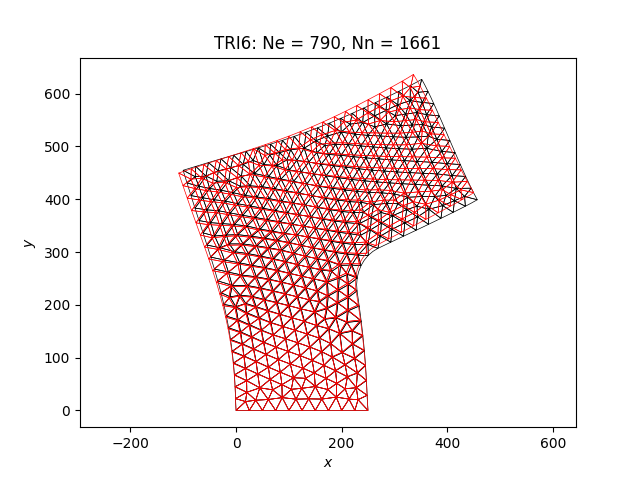
Attempt to implement hyperelasticity within an Eulerian framework.
Mesh node coordinates are updated at each loading iteration. WARNING: Implementation not validated.
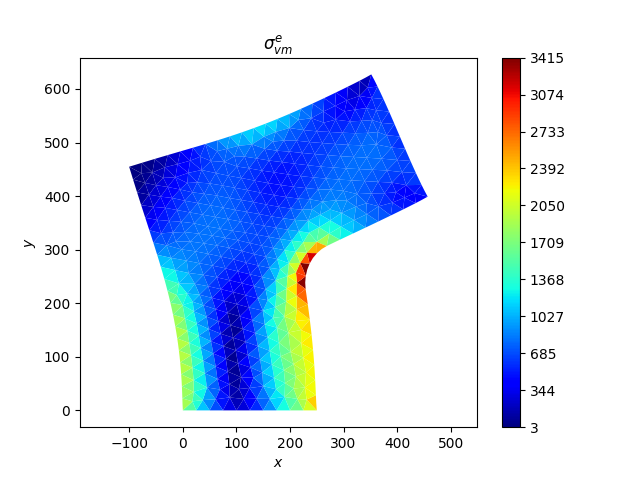
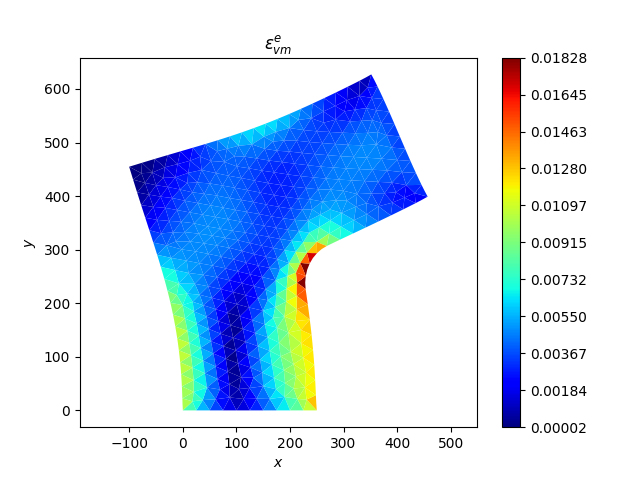
5.00 %
10.00 %
15.00 %
20.00 %
25.00 %
30.00 %
35.00 %
40.00 %
45.00 %
50.00 %
55.00 %
60.00 %
65.00 %
70.00 %
75.00 %
80.00 %
85.00 %
90.00 %
95.00 %
100.00 %

==================== Mesh ====================

Element type: TRI6
Ne = 790, Nn = 1661, dof = 3322

==================== Model ====================

ElasIsot:
E = 2.10e+05, v = 0.25
planeStress = True
thickness = 5.00e+01

solver : pypardiso

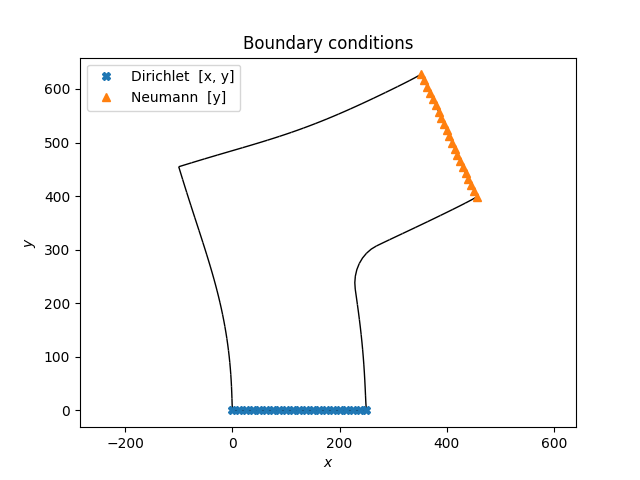
============= Boundary Conditions =============

Unspecified.

=================== Results ===================


W def = 22730944.66

Svm max = 3415.39

Evm max = 1.83 %

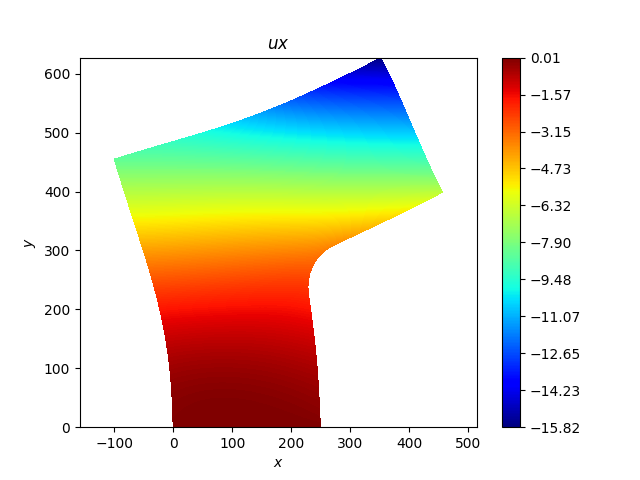
Ux max = 1.44e-02
Ux min = -1.58e+01

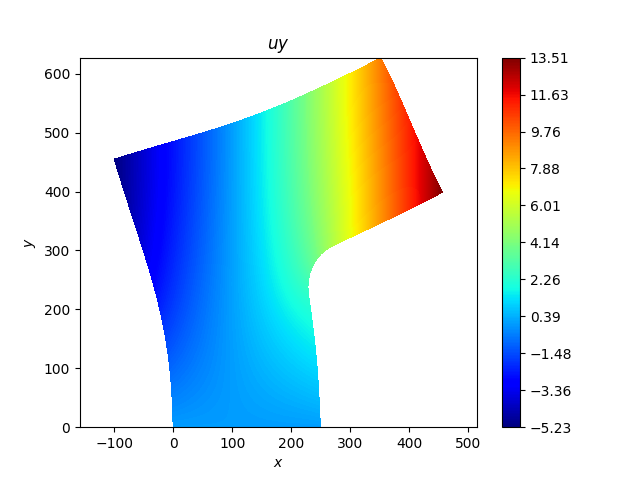
Uy max = 1.35e+01
Uy min = -5.23e+00

=================== TicTac ===================

Mesh : 2.273 s
Boundary Conditions : 1.476 ms
Matrix : 2.762 s
Solver : 2.836 s
Display : 1.322 s
PostProcessing : 377.928 ms
PyVista_Interface : 28.326 s
Paraview : 818.761 ms
 15 from EasyFEA import Display, Folder, Models, ElemType, Simulations, Paraview
 16 from EasyFEA.Geoms import Point, Points
 17
 18 if __name__ == "__main__":
 19     Display.Clear()
 20
 21     # ----------------------------------------------
 22     # Configuration
 23     # ----------------------------------------------
 24     dim = 2
 25
 26     # outputs
 27     folder = Folder.Join(Folder.RESULTS_DIR, "HyperElastic", "HyperElastic0")
 28     makeParaview = False
 29     useHyperElastic = True  # eulerian approch
 30
 31     # geom
 32     L = 250
 33     thickness = 50
 34     w = 50
 35
 36     # load
 37     sigMax = 8 * 1e5 / (w * thickness)
 38     uMax = 50
 39
 40     # ----------------------------------------------
 41     # Mesh
 42     # ----------------------------------------------
 43     meshSize = L / 10
 44
 45     p1 = Point(0, 0)
 46     p2 = Point(L, 0)
 47     p3 = Point(L, L, r=50)
 48     p4 = Point(2 * L - w, L)
 49     p5 = Point(2 * L, L)
 50     p6 = Point(2 * L, 2 * L)
 51     p7 = Point(2 * L - w, 2 * L)
 52     p8 = Point(0, 2 * L)
 53
 54     contour = Points([p1, p2, p3, p4, p5, p6, p7, p8], meshSize)
 55
 56     if dim == 2:
 57         mesh = contour.Mesh_2D([], ElemType.TRI6)
 58     else:
 59         mesh = contour.Mesh_Extrude([], [0, 0, -thickness], [3], ElemType.PRISM6)
 60
 61     nodes_y0 = mesh.Nodes_Conditions(lambda x, y, z: y == 0)
 62     nodes_Load = mesh.Nodes_Conditions(lambda x, y, z: x == 2 * L)
 63
 64     # ----------------------------------------------
 65     # Simulation
 66     # ----------------------------------------------
 67     material = Models.ElasIsot(
 68         dim, E=210000, v=0.25, planeStress=True, thickness=thickness
 69     )
 70
 71     simu = Simulations.ElasticSimu(mesh, material)
 72
 73     N = 20
 74     iter = 0
 75
 76     while iter < N:
 77         iter += 1
 78
 79         print(f"{iter / N * 100:2.2f} %", end="\r")
 80
 81         simu.Bc_Init()
 82         simu.add_dirichlet(nodes_y0, [0] * dim, simu.Get_unknowns())
 83         # simu.add_dirichlet(nodes_Load, [uMax*iter/N], ['y'])
 84         simu.add_surfLoad(nodes_Load, [sigMax * iter / N], ["y"])
 85
 86         simu.Solve()
 87
 88         simu.Save_Iter()
 89
 90         if useHyperElastic and iter != N:
 91             # update the nodes coordinates
 92
 93             newMesh = simu.mesh.copy()
 94             newMesh.coordGlob += simu.Results_displacement_matrix()
 95
 96             simu.mesh = newMesh
 97
 98             pass
 99
100     # ----------------------------------------------
101     # Results
102     # ----------------------------------------------
103
104     Display.Plot_Mesh(simu, deformFactor=1)
105     Display.Plot_BoundaryConditions(simu)
106     Display.Plot_Result(simu, "ux")
107     Display.Plot_Result(simu, "uy")
108     Display.Plot_Result(simu, "Svm", nodeValues=False)
109     Display.Plot_Result(simu, "Evm", nodeValues=False)
110
111     print(simu)
112
113     if makeParaview:
114         Paraview.Save_simu(simu, folder, elementFields=["Strain"])
115
116     Display.plt.show()
Total running time of the script: (0 minutes 0.952 seconds)